 Amalfi City Guide
Cinque Terre vs Amalfi Coast: Differences, Costs, Trails & Which to Pick
Comparing cinque terre vs amalfi coast is the classic dilemma for travelers seeking Italy's most dramatic seaside scenery, yet the two destinations deliver completely distinct vacation experiences. Cinque Terre in Liguria is a compact, pedestrianized national park where five rustic fishing hamlets are connected by a five-minute hop-on train and cliffside hiking paths. In contrast, the Amalfi Coast in Campania spans over 50 kilometers of glamorous vertical topography, celebrated for historic cathedral towns, private gozzo boat charters, clifftop Michelin dining, and luxury heritage hotels. You can discover Amalfi logistics on our what to do in Amalfi page and our Amalfi attractions overview.
Quick answer Fast verdict on whether to book Cinque Terre or the Amalfi Coast
Choose Cinque Terre if you prioritize world-class trail hiking, effortless 5-minute train hops between villages, and casual pesto-and-focaccia dining on a modest budget. Choose the Amalfi Coast if you desire glamorous coastal boat cruises, luxury clifftop hotels, rich medieval history, and romantic day trips to Capri and Ravello.
Key takeaways
- Transportation: Cinque Terre is linked by frequent trains running through mountain tunnels in 3–5 minutes; Amalfi relies primarily on passenger ferries and a scenic, narrow road.
- Hiking: Cinque Terre's Sentiero Azzurro traces the water's edge; Amalfi's Path of the Gods perches 600 meters high along sheer vertical alpine ridges.
- Budgets: Cinque Terre hotel and meal prices run approximately 30% to 40% lower than corresponding luxury standards in Positano and Amalfi.
The Fundamental Difference: Ligurian Hiking Villages vs Campanian Coastal Glamour
At first glance, both coastlines present candy-colored houses stacked dramatically against steep Mediterranean cliffs. However, their physical scale, cultural heritage, and daily rhythms differ profoundly.
Cinque Terre consists of five compact former fishing hamlets—Monterosso al Mare, Vernazza, Corniglia, Manarola, and Riomaggiore—tucked along a 12-kilometer stretch of protected UNESCO National Park. The villages are largely closed to private motor vehicles. The local railway line, tunneling through coastal headlands, connects one village to the next in just three to five minutes. Life here centers around active outdoor pursuits: trekking through terraced vineyards, grabbing freshly baked focaccia di Recco, and sipping chilled Sciacchetrà dessert wine on sun-warmed harbor boulders.
The Amalfi Coast, by comparison, is an expansive 50-kilometer maritime empire anchored by monumental history. Amalfi was one of medieval Europe's four dominant Maritime Republics, reflected in the Arab-Norman splendour of the 9th-century Duomo di Amalfi and historic paper mills at the Museo della Carta. The atmosphere is aristocratic and cosmopolitan, shaped by decades of international jet-set glamour in Positano and Ravello. Here, your days revolve around wooden gozzo boat charters, lounging on private beach lidos, indulging in multi-course seafood lunches under lemon pergolas, and embarking on day trips to Capri and Pompeii.
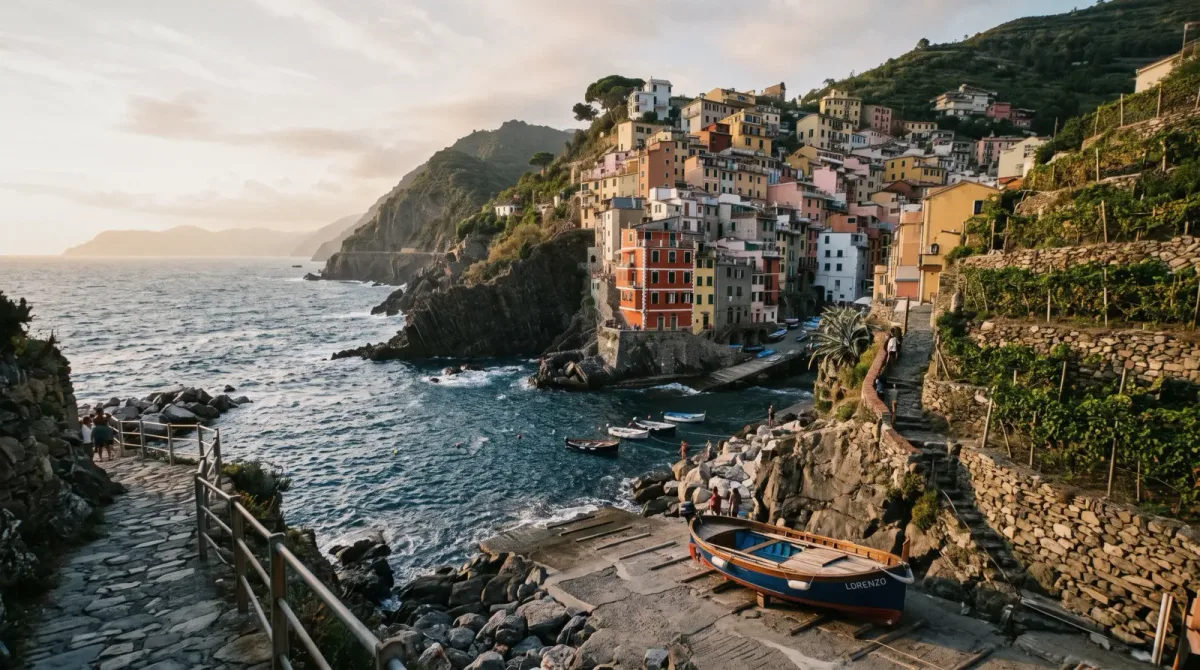
Scenic colorful cliffside Italian coastal village clinging to vertical cliffs above deep turquoise sea
Head-to-Head Comparison: Cinque Terre vs Amalfi Coast
Detailed side-by-side comparison across 8 core travel categories comparing Liguria and Campania for 2026 trip planning.
| Travel Factor | Cinque Terre (Liguria) | Amalfi Coast (Campania) | Winner & Rationale |
|---|---|---|---|
| Local Transportation | 5-minute local trains running every 15–20 minutes through tunnels | Scenic passenger ferries (€10–€20) and congested SS163 buses | Cinque Terre for speed; Amalfi for scenic sea views |
| Hiking & Trails | Sentiero Azzurro coastal cliff paths (fee required in season) | Path of the Gods & Valley of Mills (free access, high elevation) | Tie: Cinque Terre for village hops; Amalfi for sheer alpine drama |
| Beaches & Swimming | Monterosso sandy beach + deep water harbor jumping | Pebble coves, dramatic fjord beaches, private beach clubs | Amalfi Coast for dramatic secluded grottos and lidos |
| Nightly Lodging Costs | Mid-range guesthouses $140–$280 (€120–€240) per night | Mid-range hotels $240–$480 (€205–€410); luxury $800+ | Cinque Terre for budget and mid-range value |
| Dining & Gastronomy | Pesto Genovese, focaccia, anchovies, crisp white wine | Fresh scialatielli pasta, seafood, buffalo mozzarella, limoncello | Amalfi Coast for fine dining and culinary diversity |
| Geographic Accessibility | 2.5 hours by train from Florence; 3 hours from Milan | 1.5 hours train+ferry from Naples; 3.5 hours from Rome | Cinque Terre pairs with northern Italy; Amalfi with Rome/south |
| Atmosphere & Glamour | Rustic, backpacker-friendly, outdoorsy, down-to-earth | Glamorous, stylish, historic, classic Italian dolce vita | Amalfi Coast for romantic luxury and celebrations |
| Recommended Stay | 2 to 3 days is plenty to see all five villages | 4 to 6 days to explore multiple towns, Capri, and ruins | Cinque Terre for quick trips; Amalfi for longer holidays |
Pros & Cons: Evaluating Both Italian Coastlines
### Cinque Terre: Strengths and Drawbacks Why travelers love Cinque Terre: Logistics could not be simpler. With the Cinque Terre Treno Card (€19.50 per day), you can hop between Monterosso, Vernazza, Corniglia, Manarola, and Riomaggiore at a moment's notice. The entire coastline feels approachable and intimate. Hiking the cliff paths between villages offers immediate satisfaction, with vineyard-covered hills dropping directly into crystal-clear Ligurian coves.
The downsides of Cinque Terre: Because the five villages are so diminutive, midday cruise-ship tour groups arriving from La Spezia can overwhelm the narrow main streets between 11:00 and 15:30. Accommodation options consist almost entirely of basic apartments and modest guest rooms; true five-star luxury resorts simply do not exist within the park borders.
### Amalfi Coast: Strengths and Drawbacks Why travelers love the Amalfi Coast: The sheer grandeur of the landscapes is unmatched anywhere in Europe. Towering 1,000-meter cliffs plunge vertically into deep cobalt water. The region offers exceptional variety: ancient maritime history in Amalfi, dramatic garden estates in Ravello, iconic pastel cliffs in Positano, and easy hydrofoil hops to the Isle of Capri. The hotel standards include some of the world's most celebrated cliffside palaces, complemented by world-class Michelin-starred gastronomy.
The downsides of the Amalfi Coast: Getting around requires patience. The serpentine two-lane Amalfi Drive (SS163) suffers from heavy summer traffic and nerve-racking bus queues. Travelers must rely on passenger ferries, which are delightfully scenic but can be cancelled during rough sea conditions. Average prices for food, beach loungers, and accommodations are significantly higher across the board.
Our Editorial Verdict: How to Choose for Your Trip
To make your final decision, consider your starting point, total vacation length, and physical priorities:
1. Pick Cinque Terre if you are touring Northern Italy (Milan, Venice, Florence), love active day hiking without steep mountain ascents, travel on a moderate budget, or have only two or three days to spare. It is casual, energetic, and extraordinarily easy to navigate by train.
2. Pick the Amalfi Coast if your Italian itinerary centers on Rome and the south, you crave classic Mediterranean luxury, you are celebrating a honeymoon or anniversary, or you dream of spending sunny afternoons exploring sea caves on a wooden boat. The richness of historical attractions, culinary mastery, and dramatic vertical vistas make Amalfi an memorable multi-day destination.
Cinque Terre vs Amalfi Coast: Geology, Transit & Costs Compared
Side-by-side comparison of Italy’s two most famous coastal destinations to help travelers choose the right trip.
| Comparison Metric | Amalfi Coast (Campania) | Cinque Terre (Liguria) | Which Destination Wins? |
|---|---|---|---|
| Geographic Scale | 50 km of coastline, 13 distinct towns & hamlets | 12 km of coastline, 5 compact villages | Amalfi for grand road trips; Cinque Terre for walkable micro-hops. |
| Local Transit System | Ferries and cliffside SITA buses (no coastal railway) | Cinque Terre Express train (running every 15 min through tunnels) | Cinque Terre train is faster; Amalfi ferries offer far superior vistas. |
| Hiking & Footpaths | High mountain treks (Path of the Gods, 500m elevation) | Coastal cliff footpaths (Sentiero Azzurro, close to water) | Amalfi for alpine grandeur; Cinque Terre for accessible village-to-village hiking. |
| Beaches & Swimming | Pebble coves, beach clubs, private boat grottos | Small harbor ramps (Monterosso has the only large sandy beach) | Amalfi offers better private boat excursions and lido beach club culture. |
| Average Daily Cost | 25% to 40% higher lodging and dining rates | Moderate B&Bs and casual focaccerie/seafood cones | Cinque Terre is more budget-friendly; Amalfi delivers higher-end luxury. |
In-Depth Travel Comparison: Choosing the Right Italian Coast
Essential field-tested logistics, verified local guidance, and practical advice for Cinque Terre vs Amalfi Coast: Costs, Trails & Comparison.
The Transit Reality: The 5-Minute Train vs. The Vertical Cliff
The most decisive practical distinction between Cinque Terre and the Amalfi Coast is transportation infrastructure:
Cinque Terre is connected by the ultra-efficient Cinque Terre Express railway. Trains run every 15 minutes, tunneling through coastal mountains to connect the five villages (Monterosso, Vernazza, Corniglia, Manarola, Riomaggiore) in just 2 to 5 minutes each. You can wake up in Vernazza, hike to Corniglia, take the train to Monterosso for a swim, and return to Riomaggiore for dinner with zero transport stress.
The Amalfi Coast has zero coastal train service. Moving between towns requires navigating the winding, traffic-clogged SS163 road via public buses, negotiating steep stone staircases, or coordinating passenger ferries that are subject to weather cancellations. The Amalfi Coast demands much more physical stamina, patience, and logistical planning.
Atmosphere, Glamour & Accommodation Standards
How the destinations differ in vibe and traveler profile:
Amalfi Coast: Steeped in aristocratic Roman glamour, grand Mediterranean history, and high fashion. It is the realm of private wooden speedboats, infinity pools clinging to 1,000-foot cliffs, Michelin-starred cliffside dining, and luxury resort hospitality. Ideal for honeymoons, anniversary celebrations, and travelers seeking refined elegance.
Cinque Terre: Retains an unpretentious, rugged Ligurian maritime fishing culture. Village accommodation consists almost entirely of modest family-run guesthouses, small B&Bs, and converted fishermen’s rooms. The vibe is athletic and outdoorsy, populated by backpackers, trail hikers, and day trippers.
Which One Should You Choose for Your Italy Trip?
Decision guidelines based on your personal travel preferences:
- ✓ Choose Cinque Terre if: You prioritize hassle-free train transit, world-famous coastal village-to-village hiking trails, casual budget-friendly dining, and are visiting Florence or Venice.
- ✓ Choose the Amalfi Coast if: You crave dramatic romantic luxury, world-class historic sites (Pompeii and Capri), glamorous beach clubs, exquisite Campania seafood, and are combining your journey with Rome or Naples.
- ✓ Can you visit both in one trip?: Only if you have 12 or more days in Italy. Combining both in a one-week trip results in spending half your vacation on Italian high-speed trains.
Direct Head-to-Head Comparison: Geology, Hiking, Logistics & Costs
Choosing between Italy's two iconic coastal landscapes depends on your travel priorities and budget.
Topography and Scale: Dramatic Cliffs vs. Intimate Villages
The Amalfi Coast spans 50 kilometers of towering 1,000-meter limestone sea cliffs with luxury cliffside hotels, historic maritime cities, and sweeping expanses. In contrast, the Cinque Terre in Liguria comprises five compact, colorful fishing villages situated closely along an 11-kilometer stretch of coastline connected by an integrated regional train line passing through mountain tunnels.
Transit Mechanics: Train Efficiency vs. Scenic Ferries
In Cinque Terre, the Cinque Terre Express train runs every 15 minutes between La Spezia, Riomaggiore, Manarola, Corniglia, Vernazza, and Monterosso, taking only 3 to 5 minutes between towns. On the Amalfi Coast, transit depends on scenic maritime passenger ferries (April–October) or winding coastal buses that can experience severe summer traffic gridlock.
Hiking Infrastructure: National Park Trails vs. Ancient Mule Tracks
Cinque Terre features the manicured Sentiero Azzurro (Blue Trail) managed by the national park, requiring a trekking pass (€7.50–€14.50). Amalfi offers rugged, free-access mountain mule tracks and high-altitude ridges—most notably the Path of the Gods (Sentiero degli Dei) and the Valle delle Ferriere—offering more demanding climbs and dramatic vertical drops.
Budget and Accommodations: Boutique Luxury vs. Village Rooms
Amalfi commands higher baseline pricing, with world-renowned 5-star cliffside resorts, private beach clubs, and fine dining (average hotel room €250–€600/night). Cinque Terre consists largely of locally owned guesthouses, small B&Bs, and casual seafood trattorias, with average hotel costs between €150 and €350/night.
Food Culture Face-Off: Pesto & Focaccia vs. Mozzarella & Seafood
Essential field-tested logistics, verified local guidance, and practical advice for Cinque Terre vs Amalfi Coast: Costs, Trails & Comparison.
Ligurian Coastal Gastronomy vs. Campania Culinary Splendor
Culinary traditions differ radically between the two coastlines:
Cinque Terre (Liguria): Defined by simple, fragrant herbs and rustic seaside sustenance: aromatic Pesto Genovese pounded with local basil, pine nuts, and garlic; crispy, olive oil-soaked focaccia; and salted anchovies (acciughe di Monterosso) dressed with lemon and oregano, paired with crisp white Cinque Terre DOC wines.
Amalfi Coast (Campania): A far richer, more lavish culinary landscape: decadent Mozzarella di Bufala, hand-rolled Scialatielli pasta brimming with fresh clams and mussels, Cetara anchovy essence (Colatura), sun-ripened San Marzano tomatoes, and world-renowned lemon pastries like Delizia al Limone, paired with complex Costa d’Amalfi DOC wines.
2026 Practical Field Guide: Timing, Payments & Local Etiquette for Cinque Terre Vs Amalfi Coast
Crucial on-the-ground operational rules, financial realities, and daily visitor protocols to ensure a smooth, rewarding experience at Cinque Terre Vs Amalfi Coast.
Optimal Visiting Windows & Peak Crowd Flow at Cinque Terre Vs Amalfi Coast
Experiencing Cinque Terre Vs Amalfi Coast without overwhelming crowds requires understanding the sharp contrast between day-tripper hours and resident rhythms. Tour buses from Naples and Sorrento arrive along the coastal highway between 10:00 and 10:30, releasing high passenger volumes into public plazas and popular landmarks until approximately 15:30. By contrast, the early morning hours between 07:30 and 09:30 offer tranquil streets, cool temperatures, and pristine photographic light where limestone cliffs glow gold.
During July and August, midday temperatures routinely climb above 34°C (93°F); taking a midday pause in shaded cafes or valley interiors between 12:30 and 15:00 protects you from heat exhaustion while allowing you to enjoy a second sightseeing wave after 16:30 when soft evening breezes (ponente) begin to blow.
Payment Realities, Local ATMs & Avoiding Conversion Surcharges
While European legislation mandates card acceptance for retail purchases, daily life on the Amalfi Coast frequently demands physical euro cash. Municipal public restrooms (€1.00 coin turnstiles), Tabacchi bus ticket counters, coin-operated beach rinse showers, and luggage porter tips operate exclusively on cash. When withdrawing funds, steer completely clear of standalone yellow-and-blue Euronet ATMs positioned near ferry docks and souvenir shops; these third-party terminals employ predatory Dynamic Currency Conversion (DCC) models that impose stealth markups of 11% to 14% on foreign exchange.
Always use official Italian bank branch ATMs (Bancomat) operated by established national institutions such as Intesa Sanpaolo or UniCredit located on main town squares. When prompted by card terminals during restaurant or shop checkouts, always select the option to be charged in local EUR rather than your home billing currency to let your domestic bank handle conversion at interbank exchange rates.
Public Facilities, Modesty Guidelines & Hydration Points
Navigating public spaces around Cinque Terre Vs Amalfi Coast requires adherence to civic regulations and cultural norms. Historical religious sanctuaries enforce strict modesty codes: shoulders and knees must be fully covered, and visitors wearing sleeveless tops, crop tops, or short beachwear are turned away at the threshold. Keep a lightweight linen scarf or cotton wrap accessible in your daypack to drape over your body before entering historic buildings.
Municipal bylaws also prohibit walking through town streets or commercial promenades shirtless or solely in swimwear, carrying fines up to €250. Clean municipal public restrooms are situated at primary transit terminals and harbor piers, staffed throughout the day for a €1.00 fee. For hydration, seek out municipal cast-iron drinking fountains (fontanelle) that continuously dispense cold, potable mountain spring water; carrying a reusable stainless steel flask eliminates the need to purchase single-use plastic bottles while ensuring you remain well-hydrated throughout the day.
For the Amalfi Coast side of the trip, the best Amalfi tours, from Amalfi boat tours to Amalfi day tours, make it easy to keep to these dress codes without missing the highlights.
Regional Transit Coordination & Terrain Navigation: Cinque Terre Vs Amalfi Coast
Strategic transport mechanics, luggage management, and topographic realities when exploring Cinque Terre Vs Amalfi Coast and adjacent coastal destinations.
Maritime Ferry Logistics & Sea Swell Contingencies
Maritime passenger catamarans operated by Travelmar, NLG, and Positano Jet represent the fastest, most reliable method for traveling between Amalfi and neighboring coastal towns, bypassing highway traffic jams completely. During the April-to-October operating season, passenger ferries run frequent scheduled departures connecting Amalfi to Positano, Capri, Salerno, Minori, and Maiori. Boarding occurs from Molo Pennello, where passengers should queue at least 15 minutes before the departure bell.
However, travelers must monitor maritime conditions: strong southwesterly winds and heavy sea swells (mare agitato) can lead harbor masters to suspend docking at exposed piers like Positano or Amalfi. In such events, transit automatically shifts to inland SITA regional buses, causing bus terminal queues to swell. Maintaining the official SITA bus schedule on your smartphone and booking morning ferry runs—when sea swells are typically lowest—provides reliable travel security.
Luggage Transfers, Porters & Vertical Staircase Realities
The sheer limestone topography of the Amalfi Coast means that reaching hotels, guesthouses, and scenic viewpoints involves ascending dozens or hundreds of steep stone steps (scale). Wheeled suitcases cannot be rolled across ancient irregular cobblestones or up steep stairways. Travelers arriving with full-sized luggage should utilize municipal luggage storage facilities at the port (€5.00 to €8.00 per piece) or coordinate private luggage porter services directly through their accommodation or harbor kiosks (€10.00 to €15.00 per bag).
Professional porters utilize specialized motorized stair-climbing hand trucks or carry bags up steep residential alleys, sparing travelers exhausting physical strain under direct coastal sun. Packing light in carry-on backpacks or compact duffels remains the single most effective way to navigate the vertical layout of coastal settlements.
Footwear Architecture, Heat Safety & Emergency Care Protocols
Walking distances around Cinque Terre Vs Amalfi Coast accumulate rapidly, often totaling 10,000 to 16,000 steps per day across uneven stone surfaces, steep inclines, and polished marble steps that become dangerously slick when wet. Smooth leather-soled shoes, flip-flops, and high heels present serious slipping hazards; visitors should wear supportive walking shoes, trail running shoes, or sturdy hiking sandals featuring aggressive rubber tread patterns. In case of unexpected medical emergencies, dial 112 (universal European emergency service) or 118 directly for ambulance dispatch.
The primary local emergency medical clinic (Pronto Soccorso) serving the central coast is located in nearby Castiglione di Ravello, equipped with bilingual medical staff, diagnostic equipment, and triage units. Local pharmacies (farmacie) in central squares rotate emergency night shifts and can dispense over-the-counter remedies for motion sickness, dehydration, and minor sprains.
Frequently Asked Questions: Cinque Terre vs Amalfi Coast
Can I visit both Cinque Terre and the Amalfi Coast in one trip?
While technically possible, doing both on a trip under 10 days is not recommended. Traveling between them requires a 6-to-7-hour train journey linking Liguria to Campania via Florence, Rome, and Naples. It is far better to dedicate your time fully to one coastal region.
Which destination has better beaches for swimming?
Cinque Terre has Monterosso al Mare, which features the only true wide sand beach across both regions. However, the Amalfi Coast offers dramatic secluded pebble coves, turquoise sea grottos, and world-class serviced beach clubs like Marina Grande and Santa Croce accessible by boat taxi.
Is Cinque Terre cheaper than the Amalfi Coast?
Yes. On average, hotel rooms, dining, and local transport in Cinque Terre cost 25% to 40% less than equivalent mid-range and luxury standards in Positano, Amalfi town, and Ravello.
Which coastline is better for travelers with mobility concerns?
Both destinations feature steep hills, but Cinque Terre is slightly easier because the train stations in Monterosso, Vernazza, Manarola, and Riomaggiore sit close to village centers. On the Amalfi Coast, Positano and Ravello involve relentless stone staircases, though Amalfi town center provides a relatively flat pedestrian spine.
Which region offers better food and wine?
Cinque Terre excels at Ligurian comfort food: freshly pounded pesto, warm focaccia, and crisp white wines. The Amalfi Coast offers richer, more varied southern Italian gastronomy: fresh buffalo mozzarella, handmade scialatielli seafood pasta, wood-fired pizza, and artisanal limoncello.
What is the best month to visit each coast?
May and September are the golden months for both coastlines. Weather averages 22°C to 26°C with pleasant swimming temperatures, and you avoid the intense heat and overwhelming crowds of July and August.
Is the Amalfi Coast more expensive than Cinque Terre?
Yes. On average, boutique hotel accommodations, sit-down restaurant meals, and beach lido sunbed rentals on the Amalfi Coast cost 40% to 70% more than comparable services in Cinque Terre.
Which coast has better beaches for swimming?
The Amalfi Coast offers superior beach club experiences with private sun loungers, beachside trattorias, and crystal-clear deep water for swimming, while Cinque Terre has only one traditional sandy beach in Monterosso al Mare.
Which destination is easier to reach from Rome or Florence?
From Florence, Cinque Terre is closer (2.5 hours by direct train to La Spezia). From Rome, the Amalfi Coast is faster (1 hour 10 minutes on high-speed Frecciarossa to Salerno, then a 35-minute ferry to Amalfi).
Which destination has better beaches?
Monterosso al Mare in Cinque Terre has an expansive sandy beach (Fegina). The Amalfi Coast features mostly steep pebble or gravel coves, but offers more extensive private lido beach club amenities.
Can you visit both Cinque Terre and the Amalfi Coast in one 7-day trip?
It is not recommended. The two regions sit at opposite ends of Italy (Liguria in the northwest, Campania in the south). Combining them in seven days results in losing nearly two full days to travel.
What is the best way to handle tipping at Cinque Terre Vs Amalfi Coast?
Tipping is not mandatory in Italy. Most sit-down establishments include a per-person cover charge (coperto) of €2.00 to €4.00 on the final bill for bread and table setting. Leaving 5% to 10% in cash for attentive service or rounding up the bill by a few euros is a generous and appreciated gesture, but it is never expected or demanded.
Can you use international credit cards everywhere near Cinque Terre Vs Amalfi Coast?
Visa and Mastercard are accepted at virtually all hotels, sit-down restaurants, boutiques, and ferry ticket windows. However, American Express is occasionally declined by small family-run trattorias. Always carry €40.00 to €60.00 in small euro banknotes for bus tickets, espresso bars, and public restrooms.
How do you check for scheduled transport strikes (sciopero) affecting Cinque Terre Vs Amalfi Coast?
Italian transit unions occasionally stage 24-hour general strikes (sciopero). By Italian law, minimum guaranteed service windows (fasce di garanzia) operate between 06:00–09:00 and 18:00–21:00. Check the official Ministry of Infrastructure and Transport (MIT) strike calendar online or ask your hotel reception 24 hours prior to long travel days.
Prices, hours and terms are set by the venue or operator and confirmed at checkout.
We may earn a commission if you book through one of our links, at no extra cost to you. Full affiliate disclosure